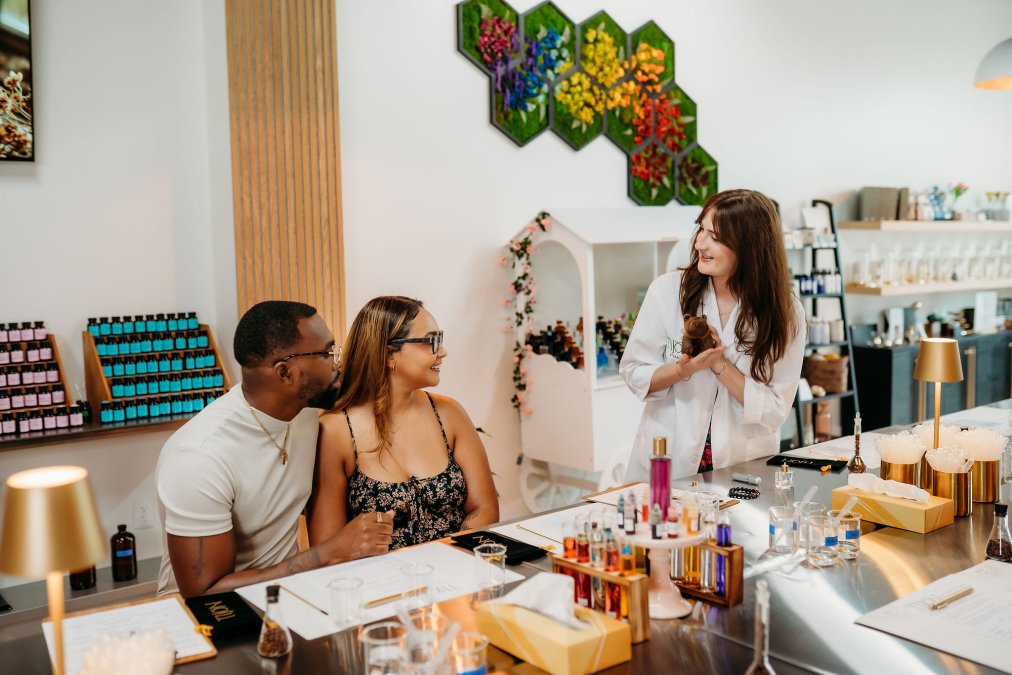
 comparison
Custom Scent vs Designer Perfume: What to Choose
Table of Contents
- Custom Scent vs Designer Perfume: The Core Difference
- How to Create a Signature Scent at a Boutique Fragrance Lab
- Inside a Guided Perfume-Making Class: Step by Step
- How Long Does It Take to Make Perfume?
- Cost and Pricing Factors: Custom Scent vs Designer Bottle
- Who Should Choose Which: A Decision Framework
- Conclusion: Matching the Choice to the Occasion
- Frequently Asked Questions
Last Updated: October 6, 2026
Custom Scent vs Designer Perfume: The Core Difference
Creating a custom scent at a boutique fragrance lab means you build the fragrance yourself, guided by a perfumer, and take home a bottle matched to your taste. Buying designer perfume means you purchase a finished, mass-produced formula created by a fragrance house and sold under a fashion label. Grand View Research perfume market analysis values the global perfume market at $60.0 billion in 2025, projected to reach $96.1 billion by 2033, and that growth is pushing more buyers toward experiences they can personalize.
Here at Tijon Fragrance Lab - Atlanta, we watch this decision play out every week. The two paths are not really competing products. They answer different questions.
What You Actually Buy in Each Scenario
With designer perfume, you buy a finished formula, a brand name, and packaging. The scent is fixed, and millions of other people wear it.
With a custom scent, you buy the process and the result: a fragrance formula built around your preferences, often with your own hands on the blotter strips. According to Scento perfume consumer behavior statistics, roughly 60% of fragrance shoppers now test scents before making a high-value purchase, which tells you how much buyers want to be sure before committing.
Factor | Custom Scent Session | Designer Perfume |
|---|---|---|
Who creates it | You, with a guide | A fragrance house perfumer |
Uniqueness | One-of-a-kind formula | Sold widely, identical bottles |
Time investment | One guided session | Minutes at a counter |
Scent testing | Live, on your skin | Limited tester sprays |
Best for | Signature identity, occasions | Instant, familiar favorites |
How to Create a Signature Scent at a Boutique Fragrance Lab
Learning how to create a signature scent starts with choosing a direction, then blending oils until the combination feels like you. At Tijon, that means working from an organ of approximately 300 oils, with a guide beside you the whole way.
You do not need any perfume background. A guided perfume-making class walks you through each decision, from the first sniff to the final blend, and we bottle your fragrance by hand in-shop to limit oxidation.
Choosing Fragrance Notes for Custom Perfume
Picking fragrance notes for custom perfume comes down to three layers. Top notes hit first and fade fast. Middle notes form the heart of the scent. Base notes anchor everything and last longest.
A common mistake is falling in love with a top note and building the whole formula around it. In practice, the base notes decide how the fragrance wears after the first hour, so we always blend with that in mind.
Inside a Guided Perfume-Making Class: Step by Step
A guided perfume-making class follows a simple arc: consult, sample, blend, refine, bottle. Most guests arrive curious and leave with something they actually wear.
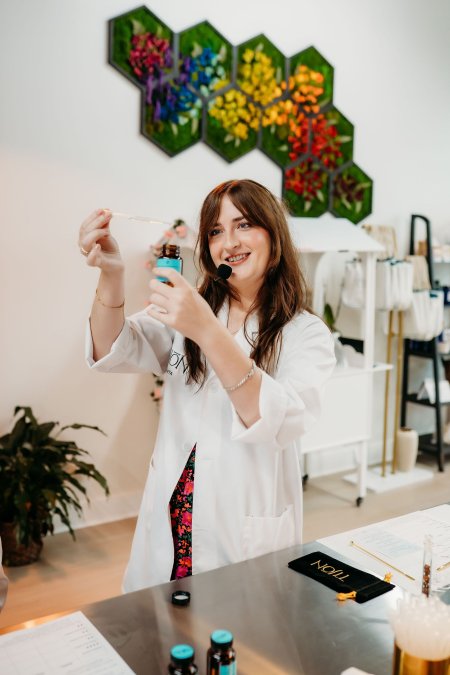
Here is how a session typically runs:
- Consultation. Your guide asks what you love and what you avoid.
- Sampling. You smell individual oils across the organ and mark favorites.
- Blending. You combine oils into a first draft formula.
- Refinement. You adjust ratios until the balance feels right.
- Bottling. We hand-bottle your fragrance on site.
According to The Future Laboratory scent retail research, consumers increasingly favor rich sensory experiences and expert guidance over passive shopping, which is exactly what a guided session delivers.
How Long Does It Take to Make Perfume?
Most guided sessions run about an hour to ninety minutes, depending on group size and how many revisions you make. Express formats shorten that window for travelers and busy schedules, while larger private groups may take a little longer to move everyone through the organ comfortably.
The blending itself is quick. The time goes into smelling, comparing, and deciding.
Cost and Pricing Factors: Custom Scent vs Designer Bottle
Most guides on this topic dodge the money question entirely, so here is the honest version: the two purchases are priced on completely different models, and understanding that model tells you more than any single number.
A designer bottle is priced per unit at retail. The brand sets one price, it is the same for everyone, and it covers the juice, the bottle, the box, the advertising, and the retail margin.
A custom session is priced as a service plus a product. That means the quote reflects things a designer bottle never has to account for:
- Guided time. A trained guide works with you one-on-one or with your group for the length of the session. That labor is the single biggest driver of the price.
- Access to the organ. You are sampling from a large library of oils rather than one tester strip. Maintaining that library, and keeping it fresh, is a real ongoing cost.
- The bottle and format. A larger bottle, a travel size, or a rollerball changes the materials cost. So does the concentration you choose.
- Group size and format. A private group booking, a bridal party, or a corporate event is priced differently from a solo walk-in, because the guide-to-guest ratio changes.
- Revisions and follow-up. If your session includes reformulation, a re-bottle, or a stored formula you can reorder later, that is built into the price.
Because of all that, reputable labs quote per booking rather than posting one flat rate, a flat rate would either overcharge solo guests or undercharge large private groups. When you request a quote, ask specifically what is included:
- How many oils you can sample and how many you can blend with.
- The size and type of bottle included.
- Whether your formula is stored so you can reorder the same scent later.
- Whether the price changes for groups, events, or add-on products like lotions, body oils, or linen sprays made in your custom scent.
That last point matters more than people expect. A custom scent is not just a perfume, many labs let you carry the same formula into body oil, massage oil, lotion, linen spray, or a car diffuser, which spreads the cost of the session across several usable products. A designer bottle cannot do that; you buy each product separately, and none of them are matched to a formula you designed.
So the fair comparison is not "custom session price versus one designer bottle." It is "custom session price versus a designer bottle plus the gift, the experience, and the personalization you would otherwise buy separately." For a solo guest treating it as a one-time experience, the custom route usually costs more up front.
- Is your formula saved on file so you can reorder the exact same scent months or years later?
- Can you get a copy of the formula, or is it kept by the lab?
- Can the same formula be made into other products, like a lotion, body oil, linen spray, or car diffuser?
A designer bottle answers none of these; you simply buy another bottle of the same product. A custom scent can answer all of them, but only if the lab records and stores your formula. That single detail separates a souvenir from a signature.
Who Should Choose Which: A Decision Framework
Choose a custom scent when you want something personal, when the occasion matters, or when you are buying for someone who has everything. Choose a designer bottle when you want a proven formula fast, or when you already know the exact scent you love.
Use this framework:
- Want a signature you cannot buy elsewhere? Custom.
- Shopping for a wedding, bridal party, or corporate event? Custom, as a shared experience.
- Need a gift in ten minutes? Designer.
- Want a date night or group activity? Custom.
- Loyal to one specific classic scent? Designer.
For events, our Wedding Fragrance & Bridal Party and Corporate Events formats let groups create together, and our Fragrance After Dark - Date Night Perfume Edition suits couples.
Conclusion: Matching the Choice to the Occasion
The harder question is not which is better, but which fits the moment. A designer bottle solves "I need a great scent now." A custom scent solves "I want a fragrance that is actually mine."
At Tijon Fragrance Lab - Atlanta, we guide you step by step through an organ of approximately 300 oils, bottle your fragrance by hand in-shop, and welcome everyone from solo guests to full bridal parties. No experience needed, just a sense of what you like.
Book a class with Tijon Fragrance Lab - Atlanta and leave with a signature scent you built yourself.
Frequently Asked Questions
What is the difference between a custom perfume and a designer perfume?
A designer perfume is a finished, mass-produced formula sold in identical bottles to millions of buyers. A custom scent is built around your selections, usually from a large oil organ, so the bottle you take home exists only for you. Designer scents go through corporate development and focus-group testing; a boutique lab session puts the blending decisions in your hands with a guide walking you through each step.
Can you create a perfume that smells like your favorite designer fragrance?
You can aim for a similar scent profile by identifying the fragrance notes you love, such as vanilla, bergamot, or sandalwood, and blending toward that direction. What you get is an inspired-by fragrance, not a replica. Exact copies are not possible because the original formulas are proprietary, and the result will carry your own twist. That difference is part of the appeal for many people.
How long does it take to make a custom perfume?
A guided perfume-making class typically runs about one to two hours, covering scent selection, blending, and bottling. An express session can be shorter, while a full custom appointment with more evaluation time runs longer. If you book a private event or bridal party, plan for extra time so a larger group can move through the oil organ without feeling rushed.
Does a custom perfume last as long as a designer perfume?
Longevity depends on concentration and the raw materials in your blend, not on whether the scent is custom or designer. A fragrance built with a strong base of woods, resins, or musk tends to last longer on skin than one dominated by light citrus top notes. Wear-test your blend over a full day before committing to a larger bottle.