 How-to
How to Create Signature Perfume: A Step-by-Step Guide
Table of Contents
- Start With Your Scent Preferences, Not a Recipe
- Understand Perfume Top Middle and Base Notes
- Gather Your Tools and Fragrance Materials
- Write a Custom Perfume Recipe You Can Repeat
- Perfume Blending Ratios for Beginners
- Test, Rest, and Refine Your Signature Perfume
- How Long Does Homemade Perfume Last?
- Frequently Asked Questions
Last Updated: October 18, 2026
Start With Your Scent Preferences, Not a Recipe
Most people try to create a signature perfume by copying an online recipe. That fails.
A signature perfume is a custom blend built around your personal scent preferences, not a pre-made product off a shelf. It begins with your nose, your memories, and the smells that make you feel like yourself.
Here's how to move from "I like vanilla" to a repeatable formula you can wear for years.
How to Sample Fragrance Families
Fragrance families are the broad categories every scent falls into. The main ones are:
- Floral: rose, jasmine, peony
- Woody: cedar, sandalwood, vetiver
- Citrus: bergamot, lemon, neroli
Smell one or two examples from each family on a blotter strip. Note which ones you want to smell again. That instinct is your starting point.
Build a Scent Profile Before You Blend
A scent profile is a short written summary of what you like and avoid. Keep it to three lines:
- Love: warm vanilla, soft woods
- Like: light citrus on top
- Avoid: heavy musk, strong rose
Bring it to your first blending session to keep from wandering.
Understand Perfume Top Middle and Base Notes
Perfume top middle and base notes are the three layers that make a fragrance unfold over time. Top notes hit first and fade fast. Middle notes form the heart.
Think of it as a timeline:
| Layer | What It Does | Typical Materials | How Long It Lasts |
|---|---|---|---|
| Top notes | First impression, bright opening | Citrus, light herbs | Minutes |
| Middle notes | The heart, main character | Florals, spices | A few hours |
| Base notes | The anchor, depth | Woods, vanilla, amber | Many hours |
A common mistake is loading up on top notes because they smell great in the bottle, the perfume then smells wonderful for ten minutes and disappears. Balance matters more than any single note.
Gather Your Tools and Fragrance Materials
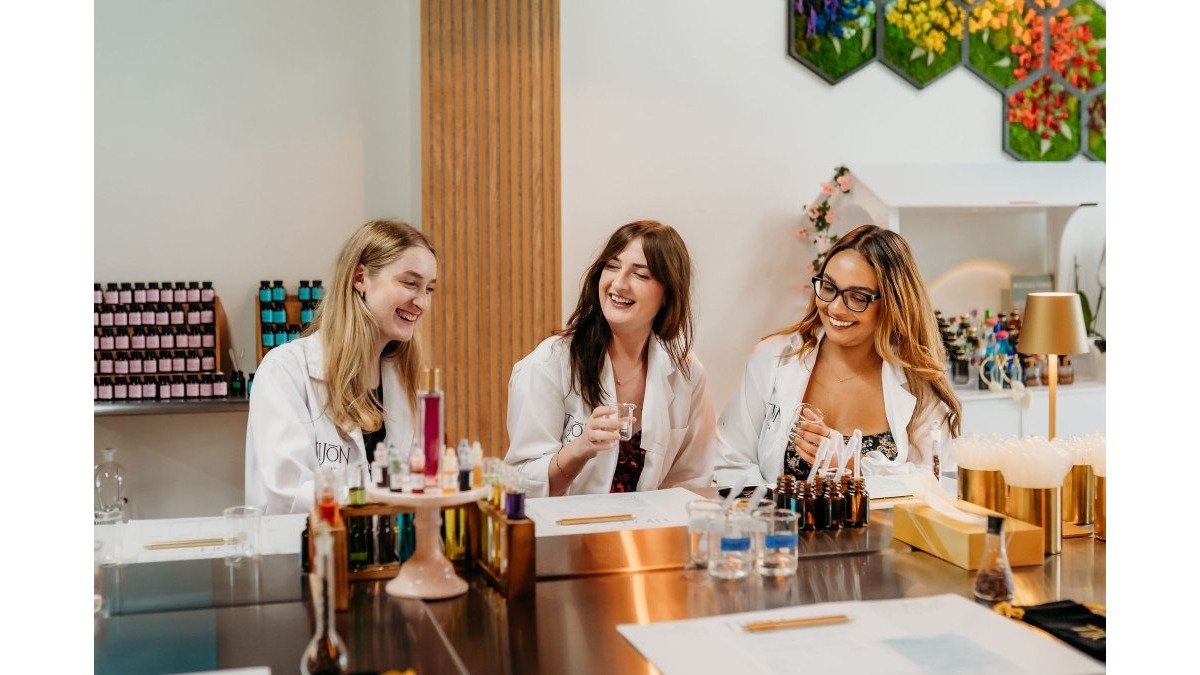
You don't need a professional lab. A basic setup covers almost everything.
Tools:
- Glass beakers or small glass cups
- Pipettes for measuring drops
- Blotter strips for testing
Materials:
- Fragrance oils or essential oils
- Perfumer's alcohol for spray perfumes
- A carrier oil like jojoba for oil-based perfumes
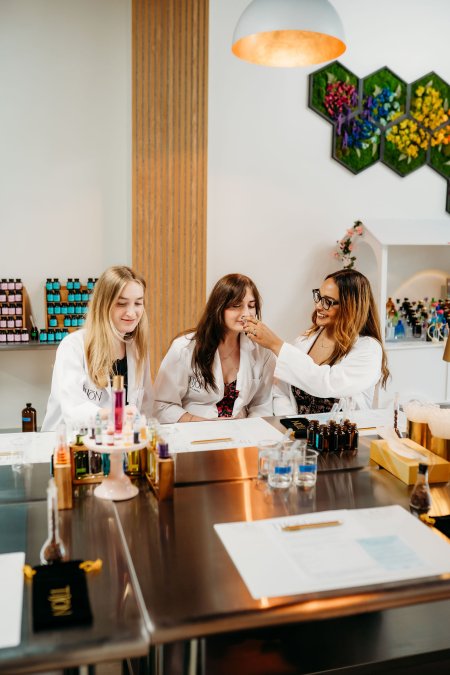
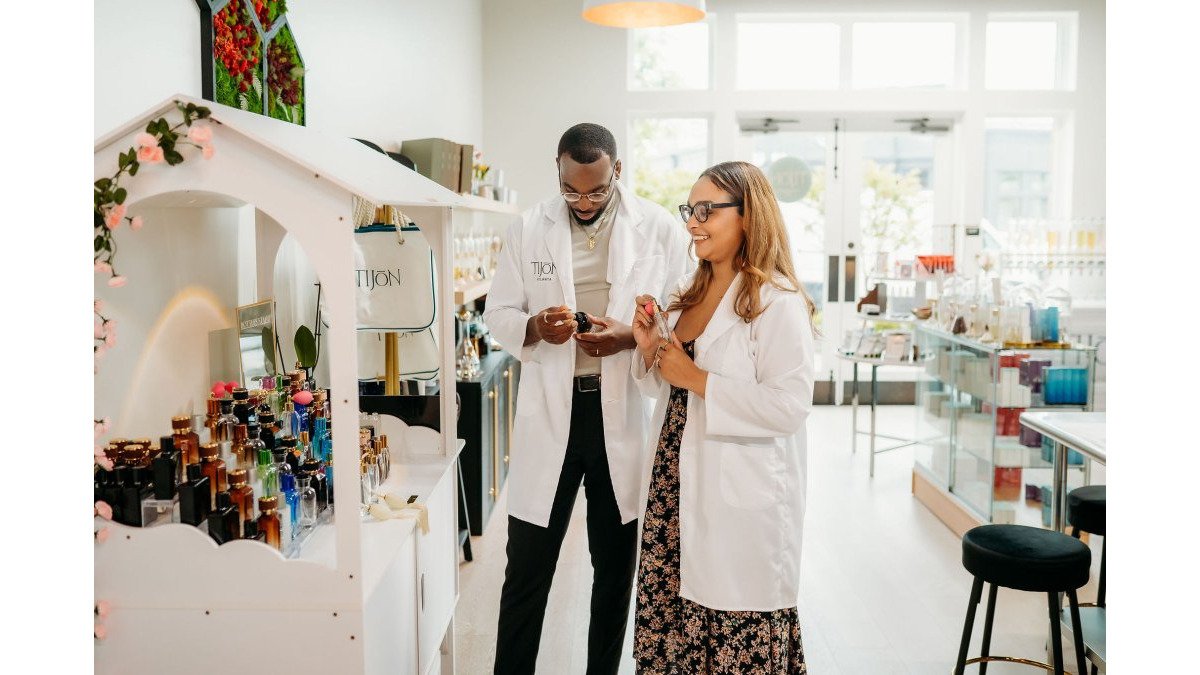
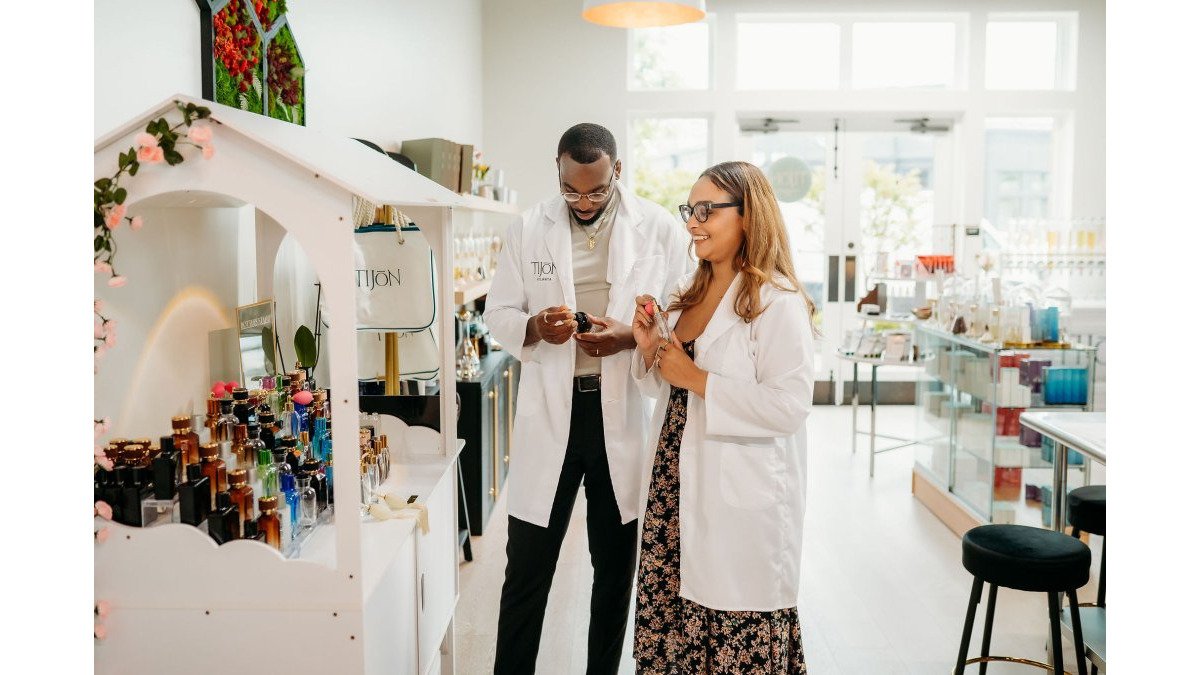
Quality shows up in the final scent. A perfumer's organ, like the roughly 300-oil collection at Tijon Fragrance Lab - Atlanta, gives you range.
Store oils in a cool, dark place. Heat and light break them down.
Write a Custom Perfume Recipe You Can Repeat
A custom perfume recipe records every material and every drop so you can make the same scent again. Without it, you have a happy accident, not a signature.
Document Every Drop
Write your formula as you go, not after. Note:
- Each material name
- The number of drops
- The order you added them
Here's a simple template you can copy:
Batch #1, [Date] Top: Bergamot, 8 drops Middle: Lavender, 6 drops Base: Vanilla, 4 drops Alcohol, 30 ml Notes: Too sharp at first. Try less bergamot next time.
That last line is the most valuable part. It turns each batch into a lesson.
Perfume Blending Ratios for Beginners
Perfume blending ratios are the proportions of top, middle, and base notes in your mix. A reliable beginner starting point is 30% top, 50% middle, and 20% base, a bright opening, a strong heart, and enough depth to last. But a ratio only becomes useful in measurable units, because "a few drops" is not repeatable.
Work in Percentages, Then Convert to Drops
Professional formulas use percentages of the total concentrate, not drop counts. Drops vary by pipette and oil viscosity, so a drop of vetiver isn't the same volume as a drop of bergamot. Percentages let you scale a batch up or down without recalculating everything.
A simple beginner workflow:
- Decide your total concentrate volume. A small trial batch of 5 ml is plenty for testing.
- Apply your ratio. At 30/50/20 on a 5 ml concentrate, that is 1.5 ml top, 2.5 ml middle, and 1.0 ml base.
- Convert to drops only for the trial. Most pipettes deliver roughly 20 drops per ml for thin oils, so 1.5 ml is about 30 drops. Treat that as an estimate, not a law.
- Once a trial works, weigh the materials on a small scale that reads to 0.01 g and record grams. Weight is the only measurement that reproduces exactly.
A Worked Beginner Formula
Here is a reproducible starting point for a 10 ml spray perfume at roughly 20% concentration, meaning about 2 ml of concentrate and 8 ml of perfumer's alcohol:
| Layer | Material | Share of concentrate | Volume in a 2 ml concentrate |
|---|---|---|---|
| Top | Bergamot | 30% | 0.6 ml |
| Middle | Lavender | 30% | 0.6 ml |
| Middle | Jasmine absolute | 20% | 0.4 ml |
| Base | Cedarwood | 12% | 0.24 ml |
| Base | Vanilla absolute | 8% | 0.16 ml |
Notice the middle and base bands are each split across two materials. Real blends rarely use one oil per layer; splitting each layer gives you room to adjust one without collapsing the structure.
How Ratio Choices Trade Off Against Performance
Changing a ratio is not free. Every adjustment buys one quality and costs another:
- More top notes sharpen the opening and add projection for the first few minutes, but shorten perceived wear because the bright materials burn off first.
- More base notes extend longevity and add weight, but too much turns the opening muddy and can make the scent feel heavy in warm weather.
- More middle notes strengthen the heart and the "identity" of the scent, but an overloaded heart can smell flat and one-dimensional after an hour.
Beginners tend to overcorrect. If a blend fades too fast, resist doubling the base, raise it a few percentage points, keep everything else fixed, and retest. Small, single-variable changes are the only way to learn what each material does.
Concentration Is a Separate Dial From Ratio
Ratio controls the balance between layers; concentration controls how much concentrate goes into the final bottle, changing strength, wear time, and suitability independently:
- Eau de toilette sits at a lower concentration and reads lighter and more casual.
- Eau de parfum sits higher and tends to wear longer and project more.
- Extrait or parfum is the most concentrated and is usually applied sparingly.
A blend that smells perfect as an eau de parfum can turn sharp or cloying at extrait strength, since the same ratio delivers far more material per spray.
If you'd rather tune ratios with guidance in the room, our guided sessions let you adjust one variable at a time with feedback before you commit to a full batch, the Most Popular Mix and Match Perfume Blending experience is a good place to start.
Test, Rest, and Refine Your Signature Perfume
Testing is where a good blend becomes a signature perfume. Freshly mixed perfume smells harsh because the materials haven't settled, so give it time and treat every test as data for adjusting the formula.
Let It Mature Before You Judge It
Maturation, or maceration, is the resting period after combining concentrate with carrier, when materials marry and sharp edges soften. Most practitioners find a freshly mixed alcohol-based perfume needs at least a couple of weeks before it reads accurately, and many keep improving over a month or more.
A practical resting routine:
- Mix the concentrate and let it sit covered for a few days to a week.
- Add the carrier, cap tightly, and store in a cool, dark place.
- Smell a small strip at one week, two weeks, and four weeks. Note the changes.
- Only judge the final character after the blend has stabilized.
Do not test a blend the day you make it and decide it failed. You are smelling an unfinished product.
Skin Testing and Wear Testing
Skin testing means applying a small amount to your wrist and watching it develop; wear testing means living with it for a full day.
Do both:
- Apply a drop to your inner wrist.
- Smell it at 10 minutes, 1 hour, and 4 hours.
- Note how it changes and how long it lasts.
- Ask one honest person if they notice it.
Skin chemistry changes everything: a blend that smells flat on a strip can bloom on skin, and vice versa. Always test on skin before committing to a full bottle.
Patch Test Before You Wear It Widely
Before wearing a new blend regularly, patch test: apply a small amount to your inner forearm and wait 24 hours, watching for redness, itching, or swelling. If you react, stop using it. Some fragrance materials are known sensitizers, and some citrus and botanicals can be phototoxic, reacting badly with sunlight. If you plan to share or sell a fragrance, check the applicable safety standards and usage limits for each material rather than guessing.
Troubleshoot the Common Failures
Most beginner problems fall into a few recognizable patterns. Match the symptom to the likely cause before you change the formula:
| Symptom | Likely cause | Adjustment |
|---|---|---|
| Fades within an hour | Too little base, or concentration too low | Raise base a few points or test at a higher concentration |
| Smells sharp or harsh | Under-matured, or too much top | Rest longer; reduce top slightly |
| Cloudy after mixing | Water or moisture in the carrier or oils | Use anhydrous alcohol and dry glassware; filter if needed |
| Sediment or particles | Undissolved resin or absolute | Let it settle, then filter through a fine filter |
| Weak projection | Over-diluted, or heavy base smothering the top | Adjust concentration or rebalance the top |
| Smells flat on skin | Middle overload, or materials clashing | Split the heart across two materials and retest |
Filtration is the fix for cloudiness and sediment that will not settle. Let the blend rest, then pass it through a fine filter into a clean bottle. Do not filter a blend you have not yet matured; you may remove material that was still marrying.
Refine One Variable at a Time
When a test says something is off, change one thing and rebatch a small trial. Fades too fast? Raise the base a few points and hold everything else. Opens too sharp? Trim the top. Record each change so you can trace which adjustment worked.
If you'd rather refine with expert eyes and noses nearby, our guided classes walk you through maturation, patch testing, and the adjustment loop with feedback at each stage.
How Long Does Homemade Perfume Last?
Homemade perfume, when stored properly in a cool, dark place, can last for an extended period. Alcohol-based perfumes tend to outlast oil-based ones, and citrus-heavy blends may fade faster than wood and resin blends.
To extend shelf life:
- Store in amber glass, never clear plastic
- Keep away from sunlight and heat
- Cap tightly after each use
If a batch starts to smell sour or looks cloudy, it has turned. Start fresh.
Frequently Asked Questions
What is the 3:1:1 rule for perfume?
The 3:1:1 rule is a common starting point for beginners learning how to create signature perfume. It means three parts base notes, one part middle notes, and one part top notes. This gives a blend that opens bright but settles into something deeper and longer-lasting. It is not a law, just a safe first formula. Adjust the ratio after you test on skin, since citrus top notes fade faster than resins and woods in the base.
Do I need a license to sell homemade perfume?
In the United States, selling perfume you make at home typically requires compliance with FDA labeling rules and, depending on your state, a business license or seller's permit. If you plan to sell, you also need to follow cosmetic labeling requirements and keep safety documentation for your ingredients. Selling a fragrance you blended for personal use is different from selling it commercially. Check with your state's business authority before you list anything for sale.
How long should I let homemade perfume rest before testing it?
Most homemade perfume blends benefit from resting at least one to two weeks before you judge them, and many improve over four to six weeks. This rest period, sometimes called maturation, lets the alcohol and oils settle so the notes stop smelling sharp or separated. Test a small drop on a blotter after week one, then again after week four. If the blend still smells harsh, give it more time before you adjust the formula.
What tools do I need to blend a custom perfume?
You need glass beakers or small mixing jars, disposable pipettes, blotter strips for testing, small amber bottles for storage, and a notebook for your custom perfume recipe. Avoid plastic cups, since fragrance oils can interact with some plastics. Label every bottle with the date and formula number so you can repeat a blend that works. A guided class supplies these tools and takes the guesswork out of measuring.
Creating a signature perfume takes patience, a written formula, and honest testing. That challenge is exactly why so many people never finish a blend they love. If you'd rather skip the guesswork, Tijon Fragrance Lab - Atlanta guides you through every step with an oil organ of roughly 300 materials, hand-bottling in-shop to protect your blend from oxidation, and no experience required. Book a class and leave with a fragrance that is genuinely yours.