 Ultimate guide
How to Choose a Signature Scent: 2026 Guide
Table of Contents
- Why Your Skin Chemistry Decides What Works
- Perfume Notes for Beginners: Top, Heart, and Base
- Fragrance Families Explained: Floral, Woody, Oriental, Fresh
- How to Test Perfume on Skin (Without Overwhelming Your Nose)
- EDT vs EDP vs Parfum: Concentration, Longevity, and Projection
- The Custom Perfume Making Process: Building a Scent From Scratch
- How to Choose a Signature Scent on a Budget
- Conclusion: Living With Your Signature Scent
- Frequently Asked Questions
Last Updated: October 4, 2026
Why Your Skin Chemistry Decides What Works
Learning how to choose signature scent starts with accepting an uncomfortable truth: the same fragrance can smell completely different on two people. Skin chemistry is the reason.
At Tijon Fragrance Lab - Atlanta, we watch this play out in every class. Someone falls for a fragrance on a paper strip, tries it on skin, and the dry down tells a different story within the hour.
The fix is simple, even if it takes patience: never judge a fragrance until it has lived on your skin for at least four hours.
Perfume Notes for Beginners: Top, Heart, and Base
Perfume notes for beginners come down to one idea: a fragrance unfolds in three stages, often called the perfume pyramid. Top notes are the first impression, lasting minutes. Heart notes (also called middle notes) emerge next and define the character for a few hours. Base notes anchor the scent and linger longest, sometimes into the next day.
This structure explains why a fragrance you dislike in the first five minutes can become something you love by evening. The opening is just the introduction, not the whole story.
A few things worth knowing before you test anything:
- Citrus, light florals, and green notes usually sit in the top
- Spices, richer florals, and fruits tend to form the heart
- Woods, musk, amber, and vanilla carry the base
- The dry down is the final phase, and it is what you actually live with all day
When you evaluate a scent, judge the dry down, not the opening spray.
Fragrance Families Explained: Floral, Woody, Oriental, Fresh
Fragrance families explained simply: most perfumes fall into four broad groups, and knowing yours narrows hundreds of options down to a handful. Floral centers on flowers, from single-note rose to complex bouquets.
Within those families you will also hear terms like gourmand (edible notes such as vanilla and caramel), chypre (citrus over mossy, patchouli base), and fougere (lavender and coumarin, the backbone of many classic men's scents).
If you are unsure where you land, think about what you already reach for. Do you gravitate toward clean and bright, warm and spicy, or deep and woody? That instinct is your starting point.
How to Test Perfume on Skin (Without Overwhelming Your Nose)
How to test perfume on skin properly comes down to three rules: test on skin, test one at a time, and give each fragrance hours to develop. Spray on a pulse point such as your inner wrist, let it sit untouched, and resist the urge to rub.
Olfactory fatigue is the hidden enemy here. Your nose stops registering a scent it has smelled continuously, usually within minutes, which is why a fragrance can seem to vanish when it is still clearly present to everyone else. Testing four or five scents back to back makes this worse, not better.
A Wear-Test Framework for Longevity and Projection
Most guides tell you to "see how long it lasts" without telling you how to measure it. Use a simple three-metric scorecard on every test wear:
- Longevity, the time from spray until you can no longer detect the scent on your own skin when you press your nose to the application point. Note it in hours.
- Projection, how far the scent travels from your body. Ask a friend to stand about an arm's length away and tell you when they can no longer smell it. This is your scent bubble.
- Sillage, the trail you leave behind. Notice whether people comment after you walk past, or only when they are close.
A practical testing routine:
- Test no more than two fragrances per visit, one on each wrist
- Note the opening, then walk away for at least an hour
- Re-smell at the two-hour and four-hour marks
- Log longevity, projection, and sillage in a notes app or on paper
- Repeat the wear test on at least three separate days before judging
- Ask for a decant or sample before committing to a full bottle
Reading the Numbers
A fragrance that projects strongly for the first hour and then sits close to the skin for six more is a different animal from one that stays loud all day. Neither is better, they suit different settings.
Skin type shifts these numbers. Dry skin tends to release scent faster, so a fragrance that lasts eight hours on someone with oilier skin may fade in four on you. That is why the scorecard matters more than any review.
Sniffing coffee beans between tests is a myth. It does not reset your nose. Fresh air does.
EDT vs EDP vs Parfum: Concentration, Longevity, and Projection
EDT, EDP, and Parfum differ mainly in fragrance concentration, which drives longevity and projection. Eau de toilette (EDT) carries a lighter concentration and typically lasts a few hours with modest sillage. Eau de parfum (EDP) is stronger, often lasting most of a day. Parfum, sometimes called extrait, is the most concentrated and the longest-lasting, but it sits closer to the skin.
| Type | Concentration | Typical Longevity | Projection | Best For |
|---|---|---|---|---|
| Eau de Toilette | Light | A few hours | Close to moderate | Daytime, warm weather |
| Eau de Parfum | Medium to strong | Most of a day | Moderate to strong | Everyday wear, evenings |
| Parfum / Extrait | Highest | Longest | Close to skin | Special occasions, cold weather |
Concentration is not the same as quality. A well-made EDT can outperform a poorly made EDP. What matters is how the fragrance behaves on your skin, which is why testing still beats reading labels.
The Custom Perfume Making Process: Building a Scent From Scratch
The custom perfume making process turns the guesswork of choosing a scent into something you build deliberately.
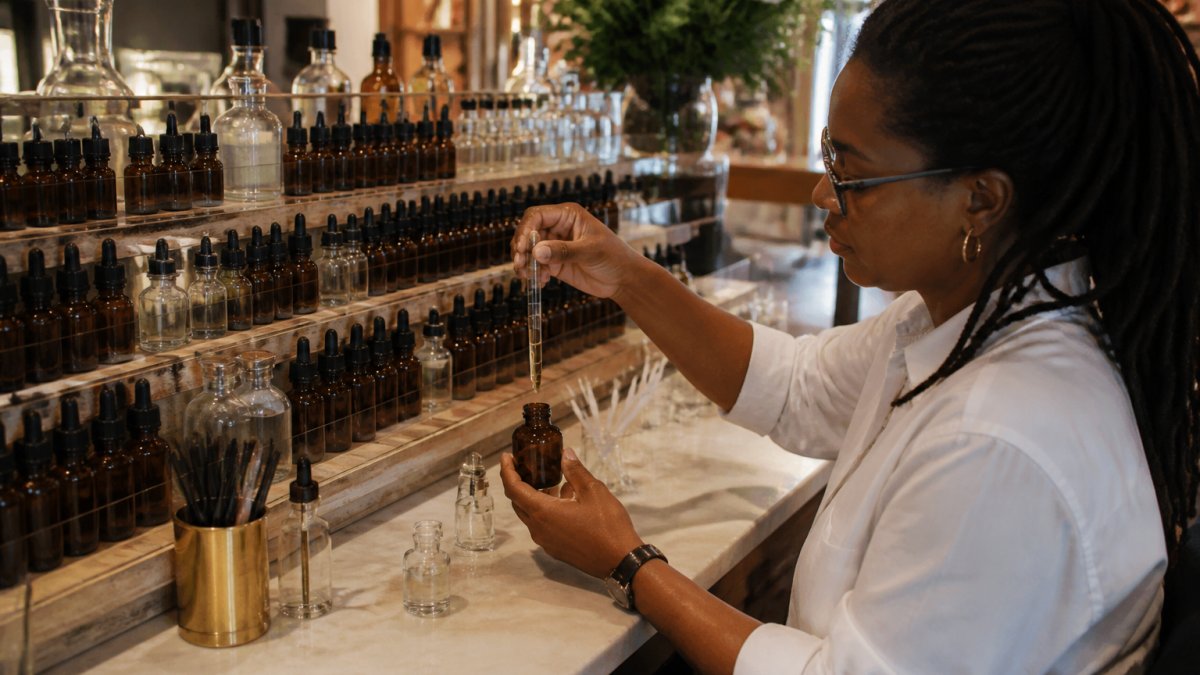
At Tijon Fragrance Lab - Atlanta, guests work with an organ of approximately 300 oils, choosing and combining notes under step-by-step guidance. No perfume background is required.
The process usually moves through a few stages:
- Explore the oil organ and identify notes that appeal to you
- Blend a small trial to test the direction
- Adjust the balance between top, heart, and base
- Finalize the formula and bottle your scent by hand
For anyone serious about a signature scent, this removes the biggest obstacle: finding a fragrance that matches your taste rather than settling for the closest commercial option.
How to Choose a Signature Scent on a Budget
Building a signature scent on a budget is entirely possible if you slow down and test before you buy. The trap is buying full bottles on impulse, only to discover the fragrance does not suit you after a week. Samples, decants, and travel sizes let you live with a scent before spending on the full size.
Know the Price Tiers Before You Shop
Signature-scent shopping spans a wide range, and the smart move is to test across tiers rather than assume price equals fit:
- Drugstore and mass-market, typically under $30 for a full bottle. Often lighter concentrations, so expect shorter longevity.
- Mid-tier designer, roughly $60 to $120 for a standard 1.7 to 3.4 oz bottle. The bulk of the market.
- Premium and niche, often $150 to $400 or more per bottle, with smaller sizes and limited distribution.
- Custom blending, a single experience priced as a class or session rather than a per-bottle retail markup, and you leave with a formula built for you.
The Decant Math
A decant is a small amount of a fragrance transferred from a full bottle into a travel atomizer, usually sold in 2 ml, 5 ml, or 10 ml sizes. A 5 ml decant of a fragrance that retails for $120 in a 3.4 oz bottle often costs a fraction of that, and 5 ml is typically enough for 30 to 50 sprays, several weeks of testing. That is the single best way to decide whether a scent earns a full bottle.
A few budget-conscious habits that work:
- Request samples with any in-store purchase
- Buy decants of fragrances you are considering before committing
- Test a scent across at least three separate wears before buying
- Build a small fragrance wardrobe of two or three versatile scents rather than a shelf of impulse buys
- Buy travel sizes first, then upgrade only the ones you actually finish
- Consider a custom blend, where you know exactly what you are getting because you made it
Cost Per Wear Beats Sticker Price
A $120 bottle worn three times a week for a year costs less per wear than a $40 bottle you regret and never touch. Track how often you actually reach for a scent before deciding it was a good buy. The cheapest fragrance is the one you wear.
Budget does not mean settling. It means testing enough to know what you actually love.
Conclusion: Living With Your Signature Scent
Finding a signature scent is less about chasing the perfect bottle and more about understanding your own skin, your preferred fragrance family, and how a scent evolves over hours. Test on skin, give each fragrance time, and let your nose, not the label, make the decision.
If you would rather build a scent that is unmistakably yours, Tijon Fragrance Lab - Atlanta offers a guided, hands-on perfume-making experience where you work with an organ of roughly 300 oils, blend your own formula, and take home a bottle filled by hand in-shop. No experience is needed, and every step is guided.
Frequently Asked Questions
How do I figure out my signature scent?
Start by identifying fragrance families you already enjoy, then test two or three scents on skin rather than paper. Wear each one for a full day to see how the top notes fade into heart notes and base notes. Note how the dry down interacts with your skin chemistry. Once a scent feels like an extension of you rather than a costume, you have found a strong signature scent candidate.
What is the 3:1:1 rule for perfume?
The 3:1:1 rule is a layering guideline: three parts base note, one part heart note, and one part top note. It helps beginners avoid overpowering one element when blending or layering fragrances. This ratio keeps the scent grounded and balanced, letting the base carry longevity while the top and heart notes add brightness and character. Adjust slightly based on the intensity of each oil.
Does a signature scent have to be expensive?
No. A signature scent is defined by how well it suits your skin chemistry and personality, not by price. Budget-conscious options include sampling decants, buying smaller bottle sizes, or creating a custom fragrance at a guided workshop where you control the ingredients. Many people find that a well-chosen affordable scent outperforms a costly one that does not match their body chemistry.
How many perfumes should a person own?
There is no fixed number, but a practical fragrance wardrobe usually includes three to five scents: one for daily wear, one for evenings, one for warm weather, one for cold weather, and one for special occasions. A signature scent is the one you reach for most often. Rotating a small collection prevents olfactory fatigue and keeps each fragrance feeling fresh.
How can I test if a perfume will last before committing to a full bottle?
Request a sample or decant and apply it to pulse points in the morning. Check the scent trail at the four-hour and eight-hour marks. Pay attention to sillage and projection, not just how it smells up close. If the dry down still appeals after a full day, the fragrance has good longevity for your skin and is worth a full bottle purchase.
Can I create a custom signature scent even if I have sensitive skin?
Yes. When working with a guided custom perfume making process, you can select from high-quality, clean ingredients and avoid known irritants. Ask about the concentration of each oil and request a patch test before finalizing your blend.